
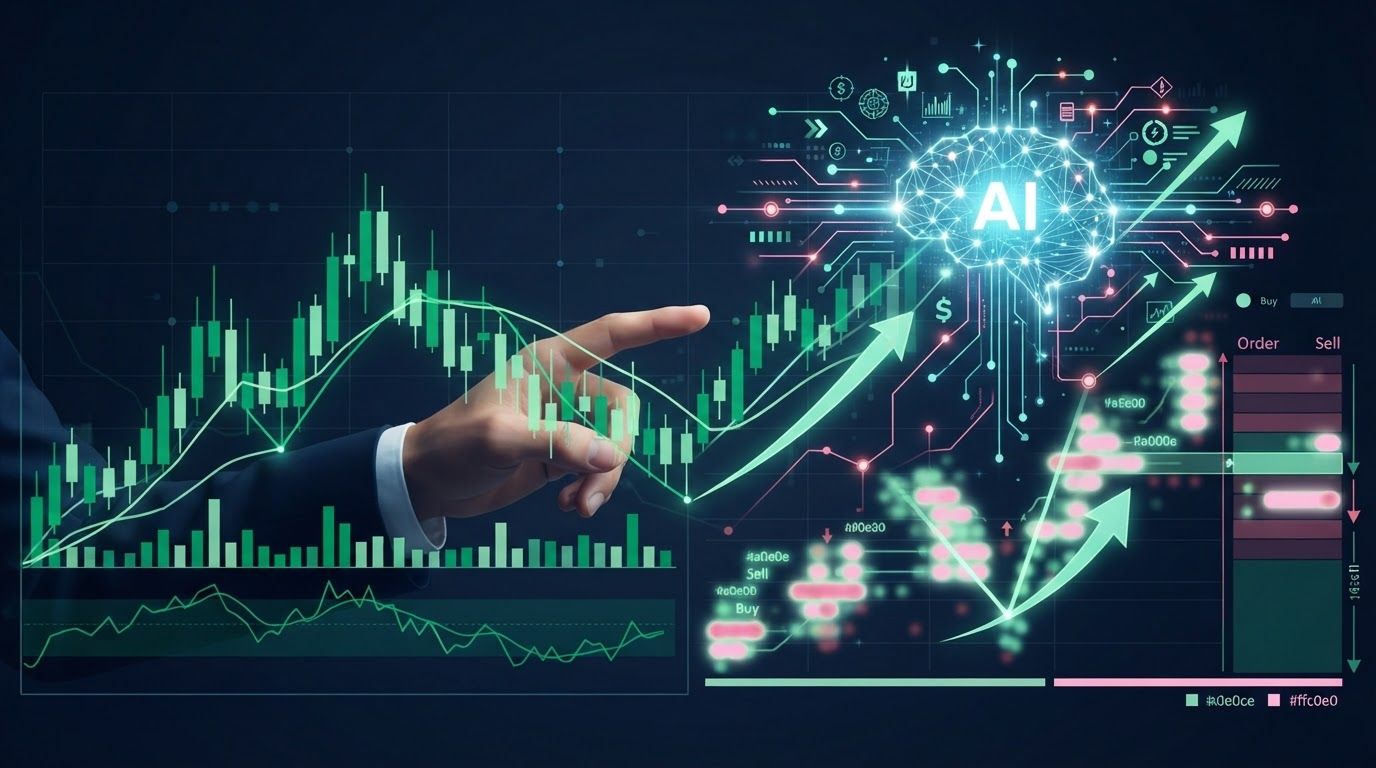
Traders need to make decisions while liquidity and prices are changing, but many familiar indicators describe what has already happened. That is why interest in AI-driven indicators and real-time order flow is growing: together, they can help traders interpret live conditions and decide whether an apparently attractive trade is executable on acceptable terms.
The shift is not simply about replacing a chart with a faster chart. Market-data providers are making live trades and order-book information easier to integrate into trading systems, while desks are connecting analytics to pre-trade planning, live execution, and post-trade review. The useful question is not whether AI can predict every move. It is where fresher data and better filtering improve a decision enough to justify their cost, complexity, and risks.
Why AI-driven indicators and real-time order flow are gaining ground
Traders are shifting toward AI-driven indicators and real-time order flow because they need timely evidence about liquidity, trading activity, and execution conditions. AI can help filter and combine those signals, but the trader still needs to judge context and handle exceptions.
A conventional indicator might summarize recent prices into a trend or momentum reading. That can be useful for describing direction, but it does not necessarily show what is happening in the order book now, whether displayed liquidity is thinning, or how readily an order might be filled. A real-time order-flow view starts closer to the trading process: what is trading, where orders are displayed, and how those conditions change as the trader acts.
CME Group’s market-data offerings emphasize live trades, top-of-book quotes, market depth, and market statistics. These are distinct inputs, not interchangeable versions of the same signal. A recent trade shows an execution; a top-of-book quote shows the best displayed prices; depth shows displayed interest at additional price levels. Looking across them can produce a more useful picture than asking a single lagging indicator to stand in for the whole market.
There is also a timing problem. Bloomberg describes capital-markets activity as healthy while execution windows have become less predictable, placing a premium on readiness rather than reaction. When a viable window may open and close quickly, an indicator that updates after a bar completes can be less useful for an execution decision than information arriving while the opportunity still exists. That does not make slower indicators obsolete; it means their job differs from the job of a live execution signal.
The attraction of AI is that it can sort a larger, faster stream of inputs into something a person can use. Bloomberg has highlighted an industry view that AI agents can monitor information around a stock and distinguish what appears relevant from noise. That is a practical ambition rather than a guarantee: a useful system should help a trader see which changes deserve attention, not manufacture confidence every time the market flickers.
What live order flow reveals that a price indicator may miss
Order flow is best understood as evidence about current trading and available displayed liquidity, not as a window into every participant’s intentions. Prices tell you where trades occurred. Live trade and book data can add context about how the market reached those prices and what a new order might encounter. For a trader deciding whether to act, that distinction can matter more than another reading of recent price momentum.
Trades, quotes, and depth answer different questions
- Live trades help show where execution is occurring and how activity changes as prices move. They record completed transactions rather than every attempted trade.
- Top-of-book data shows the best displayed bid and offer. It helps a trader see the immediate quoted market, although a quote can change before an incoming order reaches it.
- Market depth shows additional displayed bids and offers away from the best prices. It can help a trader assess where visible liquidity is concentrated and where it appears thin.
- Market statistics can provide broader context for current activity. Their value depends on the specific statistic, its update frequency, and the decision the trader is trying to make.
Consider a hypothetical trader who wants to buy after a price breaks above a recent range. A price-only signal might register the breakout. The trader can then examine current trades and the order book: is trading continuing near the new price, is the best offer moving, and is there displayed depth where the order might need to execute? None of those observations proves the breakout will last. They do help separate a directional idea from the practical question of how to enter it.
CME Group says a detailed, real-time order-book view is critical for high-frequency trading and for identifying deep liquidity pools. A trader outside high-frequency strategies can still use the underlying lesson: the amount and location of displayed liquidity affect execution choices. The relevant level of detail, however, depends on the strategy. A trader making infrequent decisions may not need the same feed, update rate, or infrastructure as a desk that continuously manages orders.
Displayed depth is not a promise of execution. Orders may be canceled or changed, and a book view does not reveal every source of liquidity or every reason participants are placing orders. Likewise, a burst of trades may reflect activity without revealing whether the next price move will continue or reverse. Reading flow responsibly means treating each observation as evidence to interpret, not as a direct forecast.
How AI turns fast market data into usable indicators
A live feed can become overwhelming before it becomes helpful. AI-driven indicators aim to transform changing inputs into a smaller set of decision-relevant observations: a shift in trading activity, an unusual change in displayed liquidity, or a mismatch between a price move and the surrounding market conditions. The value is not that the indicator has an AI label. It is that the output identifies a specific condition a trader can verify and act on.
This can involve different kinds of technology. Rules can flag straightforward conditions, such as a threshold being crossed. Machine-learning models can help rank or combine signals when the relationship among inputs is harder to specify in advance. Generative AI may help a user query data, explain an alert, or move an idea into a development workflow. These approaches should not be treated as equivalent: a readable explanation of an alert is not itself evidence that the underlying alert predicts a useful outcome.
Filtering noise without discarding context
A trader rarely needs to inspect every book update in isolation. A more useful indicator might compare what is happening now with the conditions that matter for a particular decision, then identify why it changed its assessment. If price rises while the displayed book changes rapidly, the system should be able to show the observations behind any warning or confirmation. Otherwise, it risks adding another opaque signal to an already crowded screen.
The need to combine inputs extends beyond a single instrument. Bloomberg reports that equity, credit, and rates markets have been telling different stories, pushing traders and treasurers to read across asset classes instead of relying on one indicator. For a relevant strategy, an AI-assisted workflow could bring those conflicting signals into view rather than forcing a simplistic answer. The trader would still need to decide which markets are relevant and whether a divergence changes the trade.
Data delivery is becoming more compatible with this sort of workflow. CME Group says its WebSocket API streams real-time futures and options data in JSON format directly into trading, risk, or distribution systems. That is an integration route, not a claim that connecting a feed automatically produces a good model. The indicator still needs appropriate inputs, reliable processing, a defined decision purpose, and testing against the conditions in which it will be used.
Bloomberg describes AI as a decision-support layer: generative AI can orchestrate workflows and machine learning can optimize decision engines, while the trader owns the exceptions that matter. That distinction is especially important when signals conflict. A model can draw attention to an unexpected change; responsibility for whether to pause, reduce, or continue an order should remain clear.
Why execution quality matters more than raw automation speed
The business case for automation has moved beyond placing an order as quickly as possible. Bloomberg says trading desks are increasingly adopting automation because it can improve execution performance. It reports that its Rule Builder tool saw a 15% increase in order count, a 38% increase in executed volume, and a 20% increase in trading desks using the tool from mid-2025 to mid-2026. Those figures describe activity and adoption for that tool; they do not show that every automated order performed better.
Bloomberg also reports that, among firms that automate, automated workflows outperform comparable manual ones by 5 basis points. This is a more concrete reason to examine the workflow, but it should be read within its stated comparison. It is not a promised improvement for a new strategy, every asset class, or every market condition. A firm evaluating its own results would still need to define comparable orders and measure outcomes consistently.
Real-time flow can influence execution in several distinct ways. It can help a trader decide whether to submit now, wait for more liquidity, change the size of an order, or review how an automated rule is behaving. A system that acts rapidly on stale or misleading inputs may simply make poor decisions faster. Conversely, a rule that recognizes when conditions no longer match its assumptions can be useful even if its main benefit is knowing when not to act.
Separate the trading idea from the execution decision
Suppose a strategy favors buying an instrument over the next trading session. That is a directional or portfolio decision. The execution decision asks how to pursue it as bids, offers, and trades change. An AI-driven indicator tied to live flow might inform the second question without changing the first. Keeping the two separate helps prevent a momentary order-book fluctuation from becoming an unsupported change in the investment thesis.
There are signs that more desks want machine-assisted execution. Bloomberg’s European Institutional Equity Trading Study says 25% of buy-side traders plan to increase their use of trading-algorithm providers in 2026, while 13% expect to cut back. The figures point to continued interest, not universal agreement about the right degree of automation. Some orders may benefit from standard rules; others demand close attention to unusual liquidity, urgency, or client instructions.
Bloomberg’s 2026 Global Markets & Banking Summit also frames the ability to process information and execute faster with AI as an advantage in liquidity provision and client service. Speed has value when it improves the timeliness of a sound decision. The test remains whether the resulting execution meets the trader’s objectives, not how quickly the system produced a recommendation.
How a connected analytics workflow supports better decisions
Buying a real-time feed and installing an indicator are only the beginning. Bloomberg says trading analytics are moving toward a connected lifecycle across pre-trade, in-trade, and post-trade activity. The reason is practical: access to raw data is less valuable if the analysis does not reach the person or system making the decision, or if no checks afterward whether it helped.
- Before trading, define the objective. Identify the instrument, urgency, intended order size, acceptable execution conditions, and which live inputs are relevant. A signal designed to spot a change in displayed depth cannot answer every question about the broader trade.
- During trading, connect alerts to specific choices. A change in trades or quotes might prompt a trader to review an order’s timing or size, while conflicting information might call for a pause. Make clear whether the indicator only informs a person or can trigger an automated action.
- After trading, compare decisions with outcomes. Review what the system observed, what it recommended, what the trader or rule did, and how the order executed. Include cases when an alert was ignored and cases when the system stayed quiet despite a meaningful change.
This sequence makes AI indicators easier to assess. An alert may be statistically interesting but operationally useless if it arrives too late to change an order. Another may be helpful because it consistently brings a relevant exception to attention, even if it never generates a standalone buy or sell signal. Post-trade review can distinguish those cases more clearly than a persuasive demonstration screen.
A practical review should also ask what the indicator did not know. Was it based on the relevant live market data, or on a slower substitute? Was the data available when the original decision was made? Did the evaluation include periods when displayed liquidity changed quickly? Answering those questions guards against judging an indicator with information that was only visible afterward.
The workflow should make human intervention legible rather than treating it as a failure of automation. If a trader overrides a model because the market context has changed, the reason can inform later review. Equally, a repeated pattern of unnecessary overrides may reveal that the alert needs better explanation, better calibration, or a narrower purpose. Connected analytics give teams a way to learn from both automated and manual decisions.
Where AI-assisted tools help, and where simpler alternatives win
Not every trader needs a model attached to a full-depth feed. The right tool depends on the decision, how quickly the relevant conditions change, and whether the user can act on the information. A simple price alert may be sufficient for someone checking whether a longer-horizon setup has reached a level of interest. A desk managing active orders may need live trades, top-of-book data, and depth because those inputs speak directly to the conditions in which the order will execute.
A useful way to choose is to start with the missed decision, not the product category. If a trader repeatedly finds that a price indicator fires after an execution window has closed, fresher flow data may be worth testing. If the information arrives on time but is too noisy to interpret, filtering and prioritization may be the bigger problem. If the signals are clear but orders are handled inconsistently, a well-defined rule could help before a more complex AI model is considered.
Match the tool to the question
- Use conventional price and volume indicators when the task is to summarize a historical setup or maintain a consistent view of a longer-horizon trend.
- Add real-time order-flow data when the decision depends on current trading activity, displayed liquidity, or the likely difficulty of executing an order now.
- Consider AI-assisted filtering when several live inputs compete for attention and there is a clear way to test whether the system highlights the right changes.
- Consider rule-based automation when the response to a well-defined condition is repeatable and the exceptions can be identified and managed.
These choices are not mutually exclusive. A trader might use a traditional indicator to frame a potential trade, live flow to assess entry conditions, and a rule to manage part of an order. That combination is often easier to reason about than asking one model to provide a complete answer from idea generation through execution.
Tools for building these workflows are reaching a wider audience. In a CME Group interview, Nelogica said its AI-powered Code Builder reduced the cycle from a trading idea to live execution from about one month to roughly five minutes. That describes its reported development workflow, not a general timeline or evidence that the resulting strategies are profitable. Faster implementation can accelerate useful experiments, but it also makes disciplined testing before live deployment more important.
On the consumer side, Robinhood’s CEO has said the firm’s new AI-driven agent apps aim to give individual traders tools associated with hedge funds, including 24/7 trading and autonomous agent loops. The development illustrates the mainstreaming of AI interfaces; it does not remove the need for a user to understand what an agent can do, when it operates, and how its actions can be stopped or reviewed. Accessibility and reliability are separate questions.
Limits of order-flow signals and the controls AI tools need
Order-flow intelligence can sharpen a decision without making the market fully observable. Displayed orders can change, trades show completed activity rather than future intent, and the usefulness of a book view depends on the market and data available. An indicator trained to recognize familiar patterns may perform poorly when liquidity behaves differently. Those are reasons to define its scope, not reasons to discard live information.
One risk is false precision. An AI tool may turn ambiguous activity into a neat label such as favorable or unfavorable, even when the evidence is mixed. A trader should be able to inspect the underlying observations, understand which inputs drove an alert, and see when the system lacks enough information to make a strong claim. If a generative interface explains a trading signal, its explanation should be checked against the data and the actual rule or model output.
Another risk is confusing a good backtest with a usable workflow. A historical test may rely on data that arrived after the decision point, neglect changes in the displayed book, or assume an order could be filled at a quoted price. Testing should reflect when signals were available and what choices could realistically follow. For an execution tool, it should examine actual handling and outcomes, not just whether the next price move matched an alert.
Controls should fit the level of autonomy
A dashboard that only draws attention to unusual flow needs clear definitions and a manageable alert rate. A system that recommends changes to live orders also needs a way for traders to inspect and reject those recommendations. If a rule or agent can act without a person approving each step, boundaries for permissible actions, monitoring, exception handling, and a way to halt operation become more important. More autonomy should bring more scrutiny, not less.
Order-flow analytics also matter beyond trading performance. Bloomberg says regulators expect firms to proactively detect suspicious trading behavior using data-driven indicators. Surveillance is a different use case from seeking a better fill: a pattern that warrants review is not automatically evidence of misconduct, and a trading alert is not automatically a compliance alert. Still, both uses depend on reliable data and a reviewable account of what the system detected.
The clearest division of labor is one Bloomberg describes for AI-supported desks: technology can coordinate workflows and optimize decision engines, while traders retain responsibility for consequential exceptions. That principle is useful for smaller teams as well. Automation should make unusual conditions easier to recognize and address, not hide them behind an apparently certain score.
How to judge whether the shift improves your own trading process
The strongest case for AI-driven indicators and real-time order flow is specific rather than universal. A trader should be able to name the decision being improved, the live evidence needed for that decision, and the outcome that would count as an improvement. Without those definitions, adding more data and more alerts can increase activity without increasing understanding.
Begin with a baseline. How is the decision made today, which information is available at the time, and where do delays or inconsistent judgments occur? Then test a narrowly defined addition: perhaps a live depth view for order placement, an alert that combines trades and quotes, or a rule that escalates unusual conditions to a person. Compare it with the existing process under similar circumstances rather than assuming a sophisticated interface must be better.
Measure the result against the tool’s intended job. For an execution aid, examine whether it helped achieve the desired execution outcome and whether it changed order handling in a useful way. For a filtering aid, examine whether it surfaced relevant events early enough to matter without burying the trader in false alarms. For a development aid, separate the time saved in building a strategy from evidence that the strategy works.
Finally, look for decisions the system cannot safely make. If it needs a trader to interpret cross-asset tension, assess an unusual market, or resolve conflicting instructions, design that handoff deliberately. The goal is not to remove judgment from trading. It is to give judgment timely inputs, a clear record of what happened, and a reliable way to intervene when the model’s assumptions stop fitting the market.
Real-time order flow provides a closer view of current trades and displayed liquidity; AI-driven indicators can help make that view manageable. Their combined value is greatest when they answer a defined question about timing, execution, or changing conditions rather than offering a vague promise of better predictions.
For traders considering the shift, the useful next step is to choose one recurring decision and test whether fresher data or better filtering changes it for the better. Keep the simpler tools that still do their job, measure execution and alert quality honestly, and make exceptions visible to the people responsible for acting on them.
